Tag Archives: dog

Padfoot Progress Report, January 2026

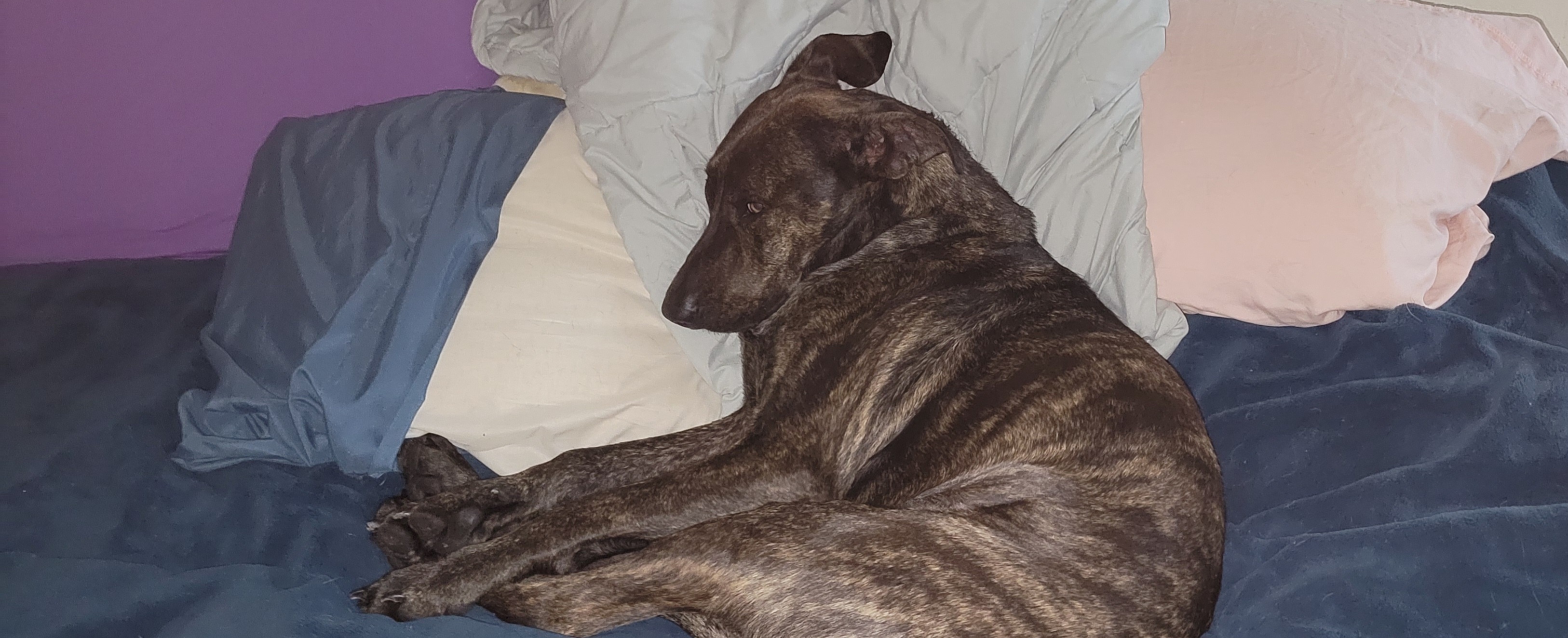
(Above: Padfoot giving me side-eye while being a bed hog.)

Recently Facebook started flooding my feed with Belgian Malinois shorts. If you’ve never seen one, they all have a macho voiceover, saying things like, “A German shepherd met a crocodile and that’s how Mom got me”. Or, “The Malinois is like a Navy Seal on meth.” The first video I saw showed a trio of Malinois body-slamming a trainer. This was everyone’s idea of fun. I saw that and thought, “Wisdom Panel lied. Padfoot is 70% Malinois but they said he was all these other things so I’d keep him.”

With his pointy face and long, skinny body, he’s built like one. He has that overdeveloped sense of mission and unbreakable comittment. And he’s deadly smart. Maybe they didn’t lie. Maybe he’s just a wannabe. Maybe he saw too many episodes of Hudson and Rex as a pup. Whatever, more than a year in, too much of my life is still spent managing him instead of living with him.

It’s frustrating because he’s being a good dog the best way he knows how. He’s a lovely companion around the house.  He’s never had an accident. He enjoys being petted. He knows the difference between his toys and my stuff. He never, not ever, not even once, bothers me while I am working on my computer. And he adores the people he met before he decided it was us against the world. 

Working with a reactive dog is like being a boiled frog in reverse, with progress in increments so small you don’t realize it’s happening. It took seeing all those videos to put it in perspective. 

  • A year ago, I had to hide in the bathroom to get dressed because he would body-slam and nip at me whenever he saw me getting ready to go out. He no longer does this. When he does invade my space, I can gently brush him aside. 
  • While he still races around like a maniac when it’s time to go out, he will settle and sit while I put on his gear. And he will hold a stay while I open the door.
  • He now lets me get out of the car first.
  • His barking is down 90%. While the mail carrier remains his mortal enemy, he is either ignoring or easily diverted from barking at other interlopers. 
  • His walks are the hardest part. Constant situational awareness remains mandatory. But it’s possible to preempt reactive episodes as long as we are a decent distance away with the 1, 2, 3 Game. (more on this in my next post) Last week he passed his neighborhood nemesis (a perfectly nice Rottweiler) twice without even a casual glance.

I’m still experimenting to find what works best with him. Group classes are out, and it makes no sense to hire a private trainer while it’s too cold to train outside. After a lot of research I bought two online training courses, both of which are helpful in different ways. More about that next month.

Padfoot Update: Calling the Shots

The single most important thing I did to manage Padfoot’s reactivity was eliminating triggers by timing neighborhood walks and finding places to walk where we could avoid people and dogs. Wesleyan Cemetery has been a godsend since it is close by and I can see anyone coming from hundreds of yards and change directions if I need to. Dog-friendly Arlington Cemetery is also great with wide roads and high visibility. If I didn’t have them, I’d look for an area zoned for light manufacturing, like the neighborhood around CARE’s Dane facility. It’s not scenic, but the roads are wide with little traffic and no foot traffic except us dog walkers. 

The theory is to use the low-trigger environment to work on our partnership so Padfoot is focused on me instead of taking his own initiative, then slowly introducing triggers. That works, to a point. It’s not in my personality to maintain heeling for a half-mile, and Padfoot rebels during longer training sessions. He’s a decent loose-leash walker and I want him to be free to smell things and enjoy himself. I suspect I am not as strict with him as most trainers would want me to be.

We are at the point where I can tell him to sit when I see him zeroing in on something, and he will switch his focus to me and actually sit (most of the time. This strategy works best if I have him sit beside a car so it blocks sight of the dog that has his attention). We are completing neighborhood walks with him only triggering once or twice, and rarely with people, as long as they are across the street.

Last week I introduced a new strategy. One of the easiest ways to train is to tell your dog to do something immediately before he’s going to do it anyway. (In addition to teaching them to correlate the behavior with the command, it kind of bamboozles your dog into thinking you are in charge.) I decided to use this strategy to remind him that I am leading and to keep his focus on me while we have a loose-leash walk.

To do this, I call shots all during our walks, even though he knows exactly where we are going: “left turn”, “right turn”, “cross” (for cross the street), “in” (for go inside), “about” (for turn around) and “walk on” (which I tell him when he stops because he’s focused on something and I am dragging him away before he goes off. Not strictly in the same category of the other commands, but hope springs eternal that he will eventually learn this one.) 

So far this is helping. Stay tuned. 

Gear

Me and Padfoot at Arlington Cemetery, where dog walkers are welcome.

Recently Desiree and I switched our Sunday morning walk from Wesleyan  to Arlington Cemetery, which is much larger and welcomes dogs. Desiree (and Felix and Padfoot) and I easily log more than 3 miles there, more than twice our distance at Wesleyan.

Padfoot has graduated from his prong collar to a martingale for our usual walks, but he’s still reactive in strange environments. Here he’s wearing a light-weight prong collar and a harness with a honking big handle on the back.

I’m not crazy about prong collars. In Padfoot’s case, he self corrects with the prong collar and is a great loose leash walker unless he’s triggered. I tried the Halti head collar—which I prefer to the Gentle Leader—but he hated it and kept biting the chin strap apart (easily replaced with cotton twill tape). I switched to the Martingale after training at CARE to handle their reactive dogs. I trust them since they handle thousands of dogs a year. They fit all their dogs with Martingales. I feel more comfortable delivering a quick correction with the Martingale than with any other kind of collar. 

In the photo I’m using the padded Halti double ended training lead. It’s designed so you can clip one end to a collar and the other end to a harness, giving you excellent control. It has rings in it so you can clip one end to make a traditional leash handle, or you can wrap it around your waist to walk hands-free. I love that it’s padded all along the length. It makes it much more comfortable to grip it at any point, necessary when you need to gain control of a lunging dog. 

I’m wearing the dog walk belt I created when I started volunteering at CARE. The belt has a roomy Cincinnati Library fanny pack on the left, where I keep a spare roll of poop bags, an ultra-sonic corrector, a can of compressed air pet corrector, and a mini air horn—which CARE dog walkers carry to call for help if they run into trouble (in my year volunteering I’ve never heard one go off). CARE also recommends shaker cans, small containers with an assorment of nuts, bolts, washers, or coins, anything that will make an obnoxious rattle.

In the center you can see a poop bag dispenser. What you can’t see is the Dalzom poop bag holder, which is a plastic device designed to hold your filled bags until you find a trash can. The red pouch on the right is for treats. For those of us who remember the original Batgirl, This setup reminds me of Barbara Gordon’s utility belt. 

I’m carrying a water pistol in my pocket, which grabs Padfoot’s attention better than all the other aversives in my arsenal. The trick with aversives is recognizing trigger situations early enough to have them in hand when you need them. Happily, I need them less and less.

If you’re wondering, my clothes are so baggy because I bought them before I lost 100 pounds on the Keto diet (another story for another time). I enjoy loose clothes so I still wear them.

Padfoot: First Steps

Have you ever looked at those lists of dog breeds, the ones that tell you the which breeds have the most of certain characteristics? It you look at lists for “most intelligent,” “most loyal,” and “most willful/independent/stubborn” you’ll see the same breeds. And most of those breeds ended up in Padfoot’s DNA. 

Please note: anything I say about dogs and dog training is my opinion, based of thirty years with street urchins I have loved. I don’t claim to be a master dog trainer. Anyway, in my experience, the more intelligent a dog is, the less “do it because I say so” will work once they reach adolescence. And the smarter a dog is, the more they are likely to rebel at dominance oriented training and the more you need to build respect. 

Think about every movie you’ve ever seen where the well-meaning do-gooder attempts to help the kid living on the streets. The kid doesn’t trust anyone but himself, lacks discipline, and has little appreciation for structure. If you want to address reactivity, jumpiness, mouthiness and pretty much anything else, it’s essential to get them to accept your leadership. Getting there requires baby steps. 

Core to teaching your dog to control their impulses are Sit, Down, and Stay. Use plenty of praise and treats in a quiet setting with no distractions. (Padfoot picked up Sit in about 5 seconds. Down requires submission and was much harder for him. Stay was impossible. I would tell him to “Stay,” and he thought it meant “Dance.” I gave up and started over with “Freeze,” and that works for us.)

Once they have mastered these commands and understand that good things happen when they listen to you, start using them in your daily routine. Ask them to Sit at the door before you open it, or when friends approach (getting in front of their impulse so they don’t jump). Tell them to Stay while you set their dinner down several feet away, and pick the bowl up if they move before you release them (don’t make them wait too long. 10 seconds is enough to get the point across). 

The more they want what is on the other side (getting to go outside, getting to eat, etc.) the more motivated they will be to listen to you. And the more they listen to you, the more they will listen to you when they encounter distractions or triggers. Progress is only ever by degrees. It’s often one step forward and two back, so mark and celebrate all the tiny wins.

I know this sounds very remedial, and it is. It’s also the path of least resistance to building trust, and it’s so easy to forget basics when you are dealing with the chaos an undisciplined dog creates.

I mentioned my arsenal of aversives earlier, and they are another important tool. I’ll talk more about them next month.

Padfoot: Breaking the Past (from the July 2025 newsletter)

Padfoot chillin’ at the dog park.

I’ve spoken to two animal communicators since I adopted Padfoot. Melissa told me that he’d once had a person, but then he didn’t, and she had seen images of him wandering down what looked like a country road (which could be many roads inside the city). She said no one would help him and when he scavenged compost heaps for food, people would chase him off with garden implements.

Donetta told me his original owner kept him confined in a small space or tied up, and when he was tied up, neighborhood kids would torment him. She said his owner was someone like a criminal, maybe a drug dealer, who wanted a mean dog to scare people. Padfoot was not given training and he was not treated well. The criminal/drug dealer/bad guy dumped him because he wasn’t mean enough.

While Melissa is new to me, I have known Donetta for decades and so many of the things she has said have been verified. Still, I have no way to know if any of this is true. But it serves to remind me that dogs too often wind up in shelters because someone didn’t care for them: a puppy that was never trained becomes totally unmanageable when it hit adolescence. Or an older dog is cast off when they become ill and incontinent. Or the dog just plain becomes inconvenient for someone who doesn’t care.

Whatever their history, all shelter dogs come with some kind of trauma. In addition to being abandoned and facing an uncertain future, there is a good chance that the owner willing to dump them did not treat them well.

As I said, I have no way to verify any of the things Melissa and Donetta said. But I have been looking at Padfoot’s behavior—the scavenging and resource guarding and his wild man antics—through the lens of this story and it all fits.

The few times I tied him up, he flipped out. I guess I would too, if it left me vulerable to abuse.

July 4th he did not bat an eye as firecrackers blew up around the neighborhood during our walk, though he became anxious that night when fireworks went off. I suspect he was used to gunfire, since that’s what firecrackers sound like.

I’ve joked that when we are out walking, he acts like he’s the Secret Service and I’m the president’s daughter. After talking to Donetta, I’m wondering if he isn’t doing his very best to be a good dog according to the rules he knows, that the dog who wasn’t mean enough is determined not to get dumped again.

He loves being petted. But as he presents himself for a chest rub, he stares into the distance with this stoic expression like he’s undergoing a humiliating medical procedure. It makes me think he’s uncertain of his reception and is waiting for the shoe to drop.

When I see his behavior through the lens of trauma, it reminds me to be patient and and kind and loving while he figures things out.

We’ve made a lot of progress. Last week Padfoot went to book club and he was great, even riding the tiny elevator with strangers. I took him to the neighborhood block party for a brief visit early on when there were only a few guests. He was friendly to everyone, if a little anxious.

He’s feaking out less in the car, spending more time with his head out the window instead of bouncing back and forth between the front and back seats while beating my head with his tail and setting off the hazard lights. (Donetta didn’t say, but I bet his prior owner never took him for car rides, either.)

He’s a terrific loose leash walker when he’s not being reactive and those reactive episodes are fewer and less intense. He’s always liked to curl up against me but he now lays his head in my lap sometimes. And more and more he is giving me eye contact with a relaxed, happy face. Sometimes I even get kisses.

We’re in a good place.

Catching Up: Circle of Life

For the past several years I have been using my newsletter as my primary means of communication. Changes in technology mean newsletters are often filtered out or buried in tabs, and a number of long-time readers have complained that they are not hearing from me. All this means it’s time to revitalize my blog.

While my newsletters will continue to provide unique content, going forward I will post my biggest stories here. Much has happened in my dog life over the past few years. July, 2023, Gypsy was diagnosed with osteosarcoma. Taking her leg gave us a year. Over the next week I will catch you up, starting with October, 2024, posted below:

I lost Gypsy shortly before her ninth birthday. It hurts to write this. It hurts to think about it. Her cancer came roaring back and she was in such distress the only thing I could do was let her go.

Mixed with grief is the sense of failure. I suspect everyone who reads this newsletter knows what I’m talking about. All the If Onlys and the Did I Do The Right Thing? and Did I Try Hard Enough?

The horrible truth is, no matter what decision we make we will second guess ourselves. Either we let them go too soon or we needlessly subject them to pain.

I loved all my dogs, but Gypsy is the one I carried strapped to my chest when she was a puupy. She was the canine version of my inner child with all her quirks and insecurities. And after years of agility, she was a partner more than a pet.

I said goodbye. for the first time in more than 8 years I locked the dog door. I swept dog hair out of the corners. I dismantled the giant beanbag I got to keep her company on the floor since she couldn’t get up on the bed anymore. I put away her things. For the first time in this century I was dogless.

I’d had a year to think about what I would do if I lost her. She left a hole so big I had nothing to give another dog and I was exhausted from all the ups and downs. I decided no dog for a year, to give myself a chance to reset. I thought about all the things I was now free to do without the responsibility of a pet. I thought I might travel.

For months I’d had in the back of my head that if I lost Gysy I would volunteer at Cincinnati Animal CARE, the organization that took over the shelter here in Northside 4 years ago. They are a no-kill shelter with an army of volunteers and an amazing array of programs designed to facillitate happy outcomes.

CARE dogs get walks and play groups and enrichment treats and even day trips. CARE provides support to assist with behavioral issues to ensure successful adoptions. Between two facilities they house 300 dogs and 100 cats, with another 200 dogs in foster care.

CARE is next to Wesleyen Cemetery, Gypsy’s happy place. I’d seen the parade of volunteers walking dogs down Colerain Avenue for years. I thought, “I can at least walk dogs.”

To be a dog walker I first had to go through volunteer orientation. Then I had to complete online training modules. then I had to have in person training about dog walking protocols.

Each walker gets a fanny pack with poop bags, treats, compressed air pet corrector, and an air horn. Walking routes are set up to keep the peace with neighbors.

Finally we were led to the gazebo where walkers congregate. Then the walk coordinator brought out this guy.

Stay Tuned.