Category Archives: On Being a Writer

Social Media for Authors: Your Platform, Pt 2

In part 1, I talked about cultivating a core group of cheerleaders for your books. Today I’ll talk about directly reaching your target audience.

Lets face it, not everyone is going to love your book. Even “To Kill a Mockingbird” has 92 1 star reviews on Amazon. So figure out who your target audience is, and find ways to connect with them. Notice, I said “connect with” not “sell to.”

If you write about what you know, you already have some connections with your target audience. Write down everything you can think of. My books have murders, mystery, romance, dogs, a dog park, a female amateur sleuth, and Cincinnati locations. My main audience is dog people who read mysteries. It behooves me to find ways to connect with dog parks, rescue groups and book clubs that cater to mysteries. Imight also be able to capitalize on the Cincinnati connection.

Next figure out what books your audience is already reading. If you can’t fit yourself cleanly into a genre, start with books YOU like to read. Presumably some of what you like has rubbed off on your writing. (I’ll talk more about connecting with these folks in a future post.)

In real life, connecting in all those places will leave you with no time to write. While face to face contacts have more value, internet contacts can be made at home, in your pajamas, in much less time. And it’s much easier for introverts.

I know, you’d much rather write. Self-publishing magnate Russell Blake advises spending 20% of your writing time in promotion. Bite the bullet. Find places on the internet where your audience is congregating and join in. Places to start are Facebook, Reddit, Pintrest, Twitter, Goodreads and thousands of special interest forums.

Pick one or two internet venues and invest time in them as a participant. Spend a little time there every day. Let people get to know you. Do NOT bring up your book unless someone asks, and if they do, keep it brief. Exercise good internet manners. Stay out of arguments, don’t feed the trolls, and don’t discuss religion or politics unless those topics are key to you as a writer. If you choose to discuss hot topics, make sure you are being calm, rational and respectful about it.

The only time to approach a group cold is if you are offering something special (not your book) that would interest them. For example, I ran a cover-dog contest on this blog, offering the prize of the cover painting to the winner. So I posted that in a variety of dog park pages, where people who own dogs would see it.

Does this sound like a pain? It can be, and if it is, it’s not going to work. Pick groups you are compatible with and make it fun. Forget about your book and focus on the group. Respond to posts, ask questions, engage. It’s more important that you invest quality time in a few places than spreading yourself all over the web.

Next, I’ll talk about some popular Social Media venues on the web.

Social Media for Authors: Your Platform, Pt 1

“What’s a platform?” I get asked this a lot. It’s a fancy name for the people interested in your work that you can sell directly to when you launch your book.  It’s also the stage you need to create BEFORE you release your book, if you want to sell books the day you launch. Everyone has some kind of platform, even if it consists of your mother and your best friend.

Nick Russell is the author of Gypsy Journal (an RV travel Newspaper) and two blogs. His thousands of readers provided a platform which sent his first book, Big Lake, to the New York Times Bestseller List.

Colleen Hoover is a gregarious social media addict who makes adventures out of her life’s foibles. She has the ability to make strangers feel like friends. Before she published her first book, she had a huge Facebook following. She also has sisters and other family who banged the drum for her to anyone who would sit still long enough to listen. Slammed made it to the NYT Bestseller List and was followed by two more titles that year.

A large initial surge of sales boosts your visibility and makes success stories like these possible. Of course, you have to have a dynamite book with a professional presentation in order for that initial surge to morph into word of mouth and lasting success.

Many folks think, “I’ll just post my book on Facebook and Tweet it, and people will buy bushels of them.” Ummm . . . it doesn’t quite work like that. That ship has sailed. Now Twitter is clogged with spam, and Facebook has changed their algorithms so that it’s harder and harder for people to see the posts they WANT to see, never mind yours.

Social media is a great tool, but when you begin to think about your platform, you need to start closer to home. Identify two groups of people: the “A” group is people around you who like you and will support you just because you’re you. Group “B” is your target audience, people who will love your book. Your first goal is to cultivate Group A in order to increase your reach to Group B.

Why? Because if you go around telling people to buy your book, you are likely to annoy them. If someone else says, “Hey, there’s this great book out, you need to read it,” they are grateful. Your best marketing is done by other people.

“How the heck am I supposed to get THAT to happen?”

I know many of you are already pulling your hair out, about how you hate marketing and are socially inhibited and . . . and . . . and.

I get it. You’re nerds, like I am. I was not gregarious in school, but I figured out this nifty thing. If you want to throw a party and get people to come, get them involved first. The person who has promised to bring the potato salad (or whatever) is going to show up, and chances are, they’ll bring a friend.

Take that thinking and apply it to your book. Instead of hiding in your closet with only the light from your laptop screen to guide you, involve other people. Let your friends and family know you’re writing a book. Consult them whenever possible. Use beta readers. Poll friends about cover designs. Allow them to share in the excitement of publishing.

A friend of mine is writing a book about a tattoo parlor. I suggested she consult with a local tattoo parlor and ask if she could pattern her fictional parlor after it, maybe even get permission to use their name. If she has a good experience with them, they are going to be bragging about being in a book. They will WANT to tell people.

Many people will volunteer to help you if you already have a connection with them. The key is, you have to be authentic about this. I didn’t ask people to shout out about “A Shot in the Bark.” They did it on their own and I’m convinced they’re responsible for the modest but respectable success my mysteries have achieved.

I’m presuming you are a nice person with a positive attitude, good manners and a good book. These are musts. If your book is not great and you go around alienating people, forget it. Being shy is not a deterrent. There are people who love to adopt shy people.

“But I write Sci-Fi. Who am I going to consult?”

Look, I can’t do everything for you, you’ve got to use your creativity to figure out ways to connect around your book. There is always something. A friend of mine writes Sci-Fi and he polled people to get weird names for the new races he was creating.

Not everyone will become your cheerleader, but some will. As a bonus, they will come up with things that never occurred to you. One of my betas thinks it would be fun if a friend of hers who is fundraising for an animal rescue did a murder mystery dinner based on my books. Even if it doesn’t work out, that’s more people talking about my books.

Get out of your hidey-hole and turn your book into a group project. You’ll be glad you did.

The 3 Faces of Creativity: Are You a Dilettante, Artist or Craftsman?

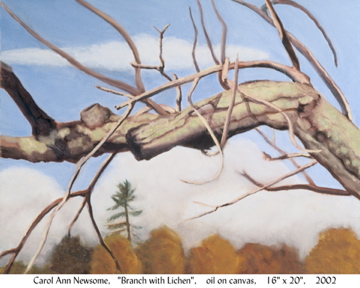
BranchwithLichen

Have you ever defended your lack of sales by saying, “I’m an Artist“? You may be right.

Yesterday morning, a deluge trapped me in the picnic shelter at the dog park with one of the other hard-core regulars. In talking about the house he was looking for, “Dave” said his fiance “Sue” had lusted after an inner-city building with one floor converted into a gallery.

I didn’t know Sue was an artist. Dave explained that she had always been too critical of her work and wound up giving it away, trashing it or painting over it. Then she went to NYC a few years ago and was disgusted with the art in the Museums. “She said, ‘my stuff was way better than this,’ and she was right.”

I began reflecting on my own creative journey with various mediums, and how attitude affects our chances for real world success. I decided there were three types of creative people. Dilettantes, Artists, and Craftsmen (or Crafts-women, or Crafts-people, or just plain Crafters).

THE DILETTANTE
I like to sing. I used to hold concerts in my car during long solo drives. On two memorable occasions, I sang back-up with friends. I used to indulge in fantasies about being onstage, singing in front of thousands of screaming fans. In my head, I auditioned for Simon Cowell and blew him away (yeah, right). Today I make up funny songs to sing to my dogs. They have multiple verses and everything. I imagine it would be fun to make a record of doggie songs one day. Meanwhile, I only sing them for my four-footers.

Notice how I’ve never had lessons, never submitted my singing to scrutiny, never worked at it, and my main value in singing is fun. I don’t do it on a regular basis. I’m easily distracted from it and have no true commitment to it. I fantasize that I’m fabulous without doing anything to get that way.

When it comes to singing, I’m a dilettante. And that’s okay as long as you know that’s what you are. The problem comes in when someone deludes themselves into thinking they will actually accomplish something of value someday. It has nothing to do with talent, of which the dilettante may have much or little.

The dilettante may actually be talented in so many things that they can’t make up their mind what they want to do. They may be serial monogamists, taking on one passion after another and dropping them when it gets tough or boring, or they may be polygamists, doing so many things at once that they never get beyond amateur status with any of it.

Being a Dilettante has everything to do with attitude, which with the Dilettante is an unwillingness to commit to one thing; to work at their medium, evaluate it with a critical eye and stick with it despite obstacles.
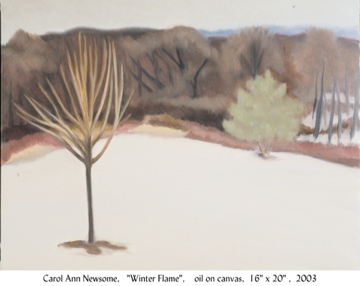
WinterFlame

THE ARTIST
I’ve been an artist all my life. I knew I was going to be a painter when I was in grade school. I totally identified with being a painter. I sold my first painting at the age of fifteen and had my first art show when I was nineteen. I went to college to study art. While I was in grad school, I told one of the other TA’s, “If I only had enough money to either eat or buy art supplies, I would by the supplies because someone will always feed me, but they won’t necessarily buy me bronze.” (I was casting statuettes at the time). I was in the studio every day and wrapped my entire life around art.

The Artist has a voice that must express itself. Sometimes it feels like channeling, with unexpected results. Always, the work justifies itself and must manifest as it must be, according to the inner urging of the artist. They rail against limitations imposed on their creativity by outside sources, such as size requirements for submission to shows, or the necessity to work according to someone else’s deadline.

The Artist is usually compelled to share their work somewhere, somehow, and is willing to accept criticism. Despite the validity of the criticism, their inner voice is their god, and their work is more precious than life.

Nothing pissed me off more than someone else picking up a paintbrush and doing something to one of my pieces. I take that back. there is one thing. While I may occasionally destroy something as not good enough, you’d better not. It’s the one way guaranteed to end our relationship. Just ask my ex-husband.

The Artist constantly strives to transcend their limitations and conversely, may stop producing in a popular body of work because they “have nothing more to say” about that particular subject. The object serves as a vehicle for a higher purpose. They often define themselves as a “process person.” They literally get high off their work and if they go too long without being creative, they become depressed.

The Artist desires recognition and often deserves it, but usually rebels against the necessity of marketing and of compromising their work to suit the market place. They find it impossible to put a price tag on it. Artists are often offended that someone would buy a painting to have “something pretty that matches the sofa.” Discussing your decorating scheme with an Artist is likely to result in fisticuffs.

THE CRAFTSMAN
A Craftsman loves what they do, but they are able to balance their work with external realities and the market place. The things they create have a purpose, whether is it to hold their coffee, look pretty on someone’s neck or entertain. Their mantra is “form follows function” and they use external limitations, such as the size of a room or its color scheme (or genre norms such as page length and themes) as springboards for their creativity. Their pleasure comes from creating a fine thing that goes out into the world and serves its purpose.

While an Artist serves their work, the Craftsman’s work serves him/her. They understand that people only buy what they want, and if you want to sell to them, you need to provide what they’re willing to buy. They expect to profit from their work and budget their investment into each project accordingly. They know when their work is “good enough” and are willing to let it go out into the world without being absolutely perfect.

They have a professional attitude about selling the output of their creative impulses and dealing with the marketplace does not make them feel dirty. They understand the concept of branding and providing a consistent product. Business people find them easy to deal with and will choose to partner with them over more talented individuals for that reason.

Craftsmen also have the healthiest response to criticism. Their assessment of their abilities is realistic and they do not identify with their work the way the Artist does. Like anyone else, they may get nervous when they put their creative efforts out before the public, but it’s not their guts hanging on display.

Most of the successful artists in the high art world have at least some Craftsman in them. It’s a dirty little secret, but the people who sell art rarely have the patience to deal with a total Artist, such as DeKooning or Van Gogh (or more recently, Basquiat). It’s their gallery and they like being the temperamental ones. The danger with the Craftsman type is that of capitalizing on one’s popularity to the point of turning out cookie-cutter creations to satisfy the market.

When it comes to my writing, I’m a craftsman. I enjoy it, but I don’t feel driven by it they way I have been driven by painting. It’s a job to me. The very best of jobs, but still a job.

Each of these types has their place and their value. The Dilettante is playful and willing to try new things. They learn from each of their creative flirtations and may be able to apply what they learn when they settle on a direction, giving them a very rich perspective. The Artist is passionately committed and unwilling to settle for mediocrity. The Craftsman is a realist and is able to manage their creative life so it supports him/her, rather than the other way around.

These three aspects of creativity function best when they are combined in one person. If you’re feeling a bit lopsided, try on a different style for a while.
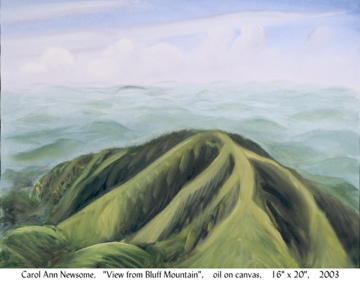
BluffMountain

How to Be a Better Beta Reader

Beta-2A

“Tell me, honestly, do these pants make me look fat?”

How many times have you wanted to answer that question with a resounding “YES! THEY HAVE ‘HINDENBURG’ WRITTEN ACROSS THE ASS! IN NEON!”

We don’t ever say it. Not if we want to keep our friends and loved ones. Our jobs. Peace with the neighbors. Tell the truth and you will be shunned. The closest we can come is a very tactful, “That’s not your best look. I like (fill in the blank) on you so much better.”

But that’s exactly what I want, need, prize in a beta reader.

What exactly is a beta reader you ask? Only the most important support person in that village it takes to get an indie book published. Indie authors cultivate a group of beta readers. These are the first people who see a manuscript, often at a point in development where it is nearly finished but not totally polished. They serve as a consumer focus group to give feedback about a book before it is published.

This is critically important to indie writer/publishers. Traditional publishing houses suffer from a huge deficit. They have a long food chain to support and they have to nurture projects that they know will sell. This results in slick, cookie-cutter books by big name authors that often play to the lowest common denominator, at the direction of their editors.

An indie author/publisher has a food chain of 1. He/she may farm out aspects of the publishing process, or an indie author may do it all themselves, editing, proof-reading, cover design and formatting. There is one thing an indie author cannot do. An indie author cannot experience their book the way a reader will.

One nifty thing about being an indie author is being able to take risks. Be different. Pursue a niche category. I don’t have to convince an editor that my book will sell. I only have to please myself and my readers. I value the beta readers who give me feedback on my books because they help me do a better job of serving my audience.

It’s hard to find good beta readers. Why? Social conditioning. The fear of hurting someone’s feelings, of offending, of damaging a relationship. So often a newbie beta reader will respond with some typo corrections and a vague “I liked it, it was good.”

Beta-1

While we really, really want you to love it, that response is always vaguely unsatisfying. I know I’m not perfect. I want to be better. In order to be better I need your raw, unfiltered, unvarnished response (okay, you can use a little tact and I won’t mind). I’ll pull on my big girl panties when I review your feedback and take care of my own ego.

My favorite beta reader once decided I was using a certain word too many times. She began numbering the instances in red pen, with the numbers getting larger with each instance. She added exclamation marks, first one, then two, then three. She circled and underlined. It let me know how annoying it was. I cut most of them out and we are still valued friends.

My usual method of working with a local beta reader is to supply them with a paper copy of the manuscript. If they don’t have a red pen, I will supply one. My fondest wish is that the reader use the red pen to scribble commentary as they go along.

I supply computer files for remote readers. In the best of all instances, they have full Word functionality on their device so they can add comments as they go along and return it to me with the comments included. Otherwise, they just take notes and send those back.

Go ahead, scrawl “BORING” right across that four page info dump. Lose track of who’s talking in a conversation? Let me know. Like something? You can put little hearts on it, I won’t mind. Did I put the bullet in his left arm in chapter 3 and bandage the bullet hole on the right arm in chapter 4? Point that out. If I say Lia rode west, into the sunrise, for heaven’s sake, correct me!

Beta-2B

Does it drag? I really, really want to know that. If it drags for you, it’ll drag for other people, too, and they won’t bother to finish the book.

I know it’s hard. It’s like telling someone their fly is down. If your fly was down, and you were about to enter a room full of people, wouldn’t you want to know?

Some Hints:

1. Be a good match. Only beta books in genres and styles you like. I stopped using one beta reader because she kept pointing me at John Grisham, her favorite writer. I am very lukewarm about John Grisham and I absolutely don’t want to be him!

2. Be yourself. Don’t try to give me the “correct” response. Give me yours. I want to now what did and didn’t work for you.

3. Read for pleasure. Make comments when you notice something, but don’t feel like you have to comment on everything.

4. Don’t rewrite my book for me. That’s my job. Stick with feedback. “Too gory” “more mushy stuff,” (or “too mushy” “more gore”).

5. We want you to be totally immersed in the world we’ve created. If anything catches your attention and jars you out of that world, point it out. It could be an obvious error, weird word usage, an overwrought metaphor or something else.

6. Don’t assume I meant to do something. When I first wrote Drool Baby, I wasn’t sure if I was going to stick with the mystery format or go for a thriller format that revealed the killer early in the book. After I decided to stick with the mystery format, I failed to erase all instances of my murderers name. None of my betas mentioned it. It was published with the killer revealed a good sixty pages before the final confrontation. (It was corrected soon after, thankfully)

7. If you happen to catch a typo, sure, go ahead and mark it, but don’t search for them. I’d rather you were in the flow of the book instead. I’ve got someone else who proofreads. It’s a different mindset.

8. I may agree with you or I may not. Your opinion still provides valuable information to me.

Authors – Do you have any tips/hints for beta readers you’d like to add?

Pass Me another Dead Body, Will You?

Back in the day, long before I ever thought I’d write novels, a woman named Karen Shaffer invited me to bring my signature good-will guerrilla art project, New Leaf, to Abingdon, VA for an arts festival.

There I met her husband, Charles Vess. If you’ve never heard of Charles Vess, he’s an amazing illustrator who became disenchanted with drawing Spiderman for Marvel Comics. When I met him, he had just finished collaborating with Neil Gaiman on Stardust.

He told me he got tired of brawn being the ultimate solution in the comic book world. He went looking for stories that were resolved through ingenuity instead. Fast forward some years, and Stardust is made into a major motion picture featuring both Michelle Pfieffer and Robert De Niro. What does Hollywood do to this terrific book? They tossed in a lot of the POW! BAM! that Charles had turned his back on.

I enjoyed the movie and have watched it several times. I do not enjoy it more than the book despite the appearance of Robert De Niro in a :-X (sorry, can’t tell you. I don’t do spoilers).

As I was considering my recent review of Elysium, I remembered this bit of irony, and it brought to mind popular plot devices (read: lazy shortcuts) that disturb me as a mystery novelist.

One of the most over-abused practices: “If the pace drags, kill someone.”

This has become so popular that even romantic suspense writers such as Amanda Quick now litter their books with multiple corpses. When she started her writing career, one dead body would do just fine.

I’m not a prude about dead bodies. My first two books were about a serial killer (it says that, right in the blurb). But there just aren’t all that many serial killers out there, and ordinary, run of the mill murderers do not normally leave a trail of bodies behind them to cover up their crimes.

So I’m in the middle of novel number three, and I’m thinking about pacing without the easy device of gratuitous murder. I read some experts.

What do writing gurus have to say about plotting? There are variations on the exact wording, but the common wisdom is that “A plot is a series of disasters that get progressively worse as the book goes along until the triumph (or not) of the final confrontation.”

Seriously? I like to think my characters are smarter than that.

This makes me think about Patricia Cornwell, whose books I used to love until the exacerbating negativity finally got to me. The last book she wrote, I’d finally had enough. Within the first two pages, Kay Scarpetta is fuming about some bit of incompetence engineered by Pete Marino. She’s kept this guy around for twenty years with all the stuff he’s pulled and she hasn’t gotten rid of him? Why does everyone she works with eventually betray her? Is she that big a bitch?

And what about Lucy and Benton? Why do we never see her having a good time with the two people she loves most? Does she really love anyone? Why hasn’t someone sent her to the therapist she so obviously needs? This is entertainment?

So, yes, a novel needs obstacles or it isn’t compelling, or even real. But I like some triumphs and good times, too.

Other devices that annoy me: undetectable poisons that kill rapidly in tiny amounts, over-reliance on a network of readily available informants, silenced guns that are actually silent, same day DNA tests, and protagonists who have more money than God so they can drive around in fancy cars and fly to Bimini to pursue clues at the drop of a hat.

Edit: My friend, Jacques, just reminded me about duct-work large enough for a football lineman to crawl through. Doh.

Edit #2: More of a movie convention, but still worth mentioning: Endless thugs that multiply like tribbles, especially the ones who teleport in front of you, no matter how fast you’re going or how many times you’ve eluded them.

Where am I going with this rant? I have a small request to make. While I might slip from time to time, if I ever become reliant on such silly devices, please put a drop of that undetectable poison in my coffee and put me out of my misery.

Some Really Great Advice About Writing and Everything Else

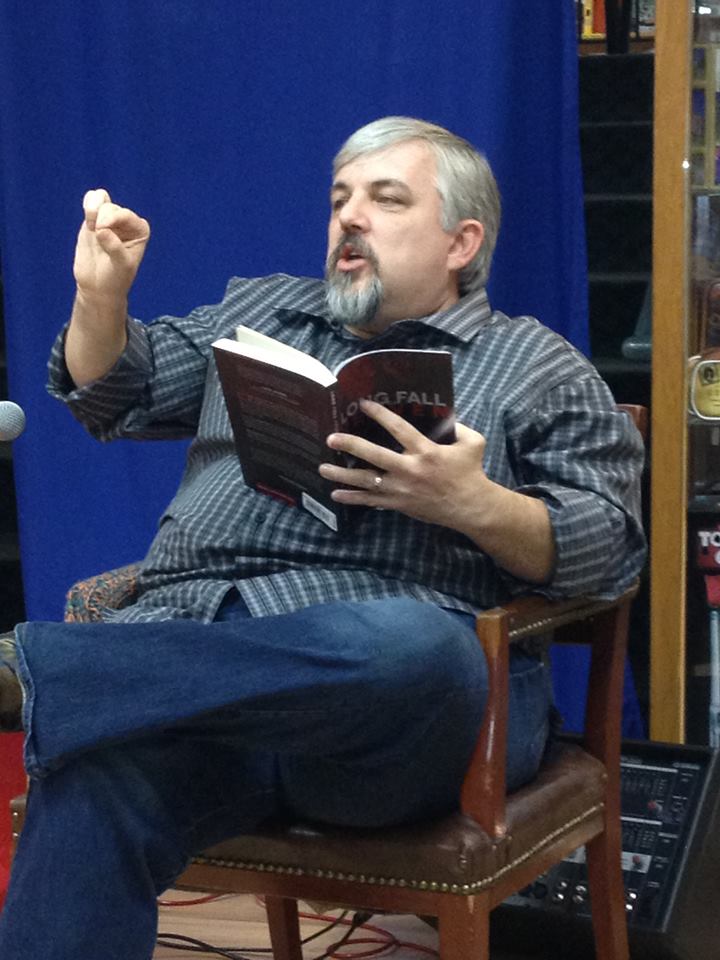
George Wier, if you haven’t heard of him, is author of the Bill Travis Mysteries. These days he is spending most of his time hopping around the Southwest doing book signings for Long Fall From Heaven. He still finds time to pop into our online writer’s group.

George at a recent book convention

Last night he shared the following. This beautiful little essay on writing had me thinking of the New York Sun op-ed piece written over a hundred years ago. You know the one I mean. It begins, “Yes, Virginia, there is a Santa Claus.”

Here’s George:

A bit of advice I gave someone yesterday on writing. Maybe I should start paying attention to it myself:

Marc,

While I would never dissuade you from reading other writers, or reading as much as you can on the subject of writing, I suggest that you dive in head first. As a reader you know what you like to read. I suggest you write exactly what you yourself like to read, and nothing more. Also, you should start writing out of the blue. In fact, get used to writing the moment (if possible) an idea hits you so that what you put down can be raw and true and from the gut. There ARE NO authorities on writing. You are the authority on your OWN writing. Period. So, write for you, first. Second, write a lot. Hone your skills, either over time or through a high degree of output, or both (as it usually works out that way anyway). As far as the “length” of what you should write, forget about length. Right now, at this stage, that’s not even in the equation. A story is it’s own universe, just as I say in the videos. It has it’s own internal laws. And what you write in a story will come out right if you pay ZERO attention to length, or whether there’s too much dialogue, or not enough of this or that, or whatever. Don’t put your attention on anything other than telling the story. And… at BEST, the story will begin to write itself. You’ll know what this feels like when it begins to happen. There is no other feeling quite like it. For me it is like being carried along by a strong current. It has swept you out to the middle of the channel and it is taking you somewhere. It’s best not to fight it, but to instead go along. Don’t bother swimming against the current, or even necessarily WITH the current, and definitely not towards shore. Just tuck your hands behind your head and let that story carry you along. That’s the best advice I can give.

So, Marc, what I want you to do is…today, or tomorrow, or as soon as you can, sit down and write something. And don’t worry about whether it’s good or not. Just write it. For it’s own sake. And that is really all there is. I could teach a seminar for weeks on the subject, but really, it all comes down to just this paragraph. Just…write.

Here’s George again, snuggling with his dog:

George and Casey
George and Casey

Audiobook Giveaway!

Okay, so I recently published the audiobook version of A Shot in the Bark, and Audible sent me a few free codes for my personal use. And I thought, I don’t want to give these to my friends, they are the only people I can count on to buy my stuff. And I don’t know any audiobook reviewers (if you do, please let me know!) to send them to.

So that leaves raffling them off.

If you’re wondering what I’m talking about, click on the cover below to go to Audible.com, where you can listen to the first five minutes of Jane Boyer’s fantastic narration.

ShotACX4sm

Are you hooked?

I was, the first time I heard Jane’s voice on her audio samples. And you can have more than 7 glorious hours (okay, it’s actually 7 hours and 42 minutes) of Jane bringing Lia, Peter, Bailey, Anna and the rest to life.

If you’d like the chance to win a copy for your very own self, click on the link below to go to Rafflecopter.

a Rafflecopter giveaway

You’ll get entries for liking my Facebook page and following me on Twitter. You can get extra entries for tweeting once a day.

The contest runs through June 29th.

If all this seems like too much fuss, you can always just surf back over to Audible and shell out 17.95. But what fun would that be?

Your Dog Could Be A Star!

Llightning
Lightning

Is your dog the reincarnation of Houdini? Can he find his way out of tight places? Is no fence safe?

I need a cover dog. And I’m willing to give the finished oil painting portrait of this dog (16″ x 20″ or larger) to whomever supplies me with the photo after I’m done photographing it for the cover. The winner gets the painting, I keep the reproduction rights. The winner and canine will also get an attribution in my book, along with a brief profile.*

The name of the book is Maximum Security. It features my dog Max as an escape artist. Only problem is, I featured Max on the cover of A Shot in the Bark and I can’t use her again. So I need another dog face.

Chanel
Chanel

I need a decent photo of a dog squeezing under a fence or other tight place. It must include the dog’s face, from the front or a slight angle. Extra credit for a manic look in the eyes. The more expressive, the better! More points for rescues. You can submit as many photos as you like. You don’t need to be a professional photographer, just be able to capture the face and have it in focus. I’ll post my favorites on this blog. Send your photo to carolannnewsome@netzero.net Put “Caught in the Act!” in the subject line.

You must have taken the photo yourself and either own the dog or have the owner’s permission.

Rose and Izzy
Rose and Izzy

I expect to be working on the painting in August or September, so there’s plenty of time to take pictures. As an enticement, I am posting photos of prior covers and other pet portraits so you can see what I do. We’ll say the deadline is July 30, 2013.

Drool Baby
Kita
Max
Max
Max's Portrait
Max’s Portrait
cover for soon-to-be-released audiobook
Cover for soon-to-be-released audiobook

*By submitting your photo to this contest, you are giving me permission to post it on this blog. If your photo is selected, you are giving me permission to use it as source material for a painting to be used as a cover on my up-coming book, Maximum Security, and for other commercial purposes.The winner will receive the finished painting and no other compensation. The winner receives bragging rights only, and does not receive any reproduction rights associated with the finished painting.

Aztec Diet Day 38: Little Foil Men

Pounds lost: 18

Pre-Breakfast: apple; Breakfast: Dr. Bob’s Kale Blueberry Smoothie; Lunch: venison stew; Snack: apple; Dinner: low-fat cottage cheese with 2 TBSP chia, topped with an avocado and peach mango salsa; Snack: 2 celery ribs and a small handful of zucchini chips

New Crocs

I think my absences in the evening are upsetting Shadda. This morning I couldn’t find one of my Crocs. After hunting all over the apartment, I found it in one of the dog beds with the strap chewed off. This is the first time she’s eaten one of my shoes in a couple years. So maybe she misses me. Or maybe she’s just tired of me wearing these everywhere, looking like some kind of duck-footed dork.

I’m getting tired of tuna. And venison. I’m longing for a lovely pot of curried black beans. I was thinking about that tonight. Then I looked around me. More than 60 people in my work room, with stations every 4 feet. A sudden influx of beans would be horribly antisocial. That means humus is out, too. Dang it. Curse real jobs, and the need for social acceptability.

I did better than ever with not being hungry at work. I believe stirring 2 TBSP chia into my cottage cheese did the trick. It made a nice meal with avocado and salsa. It’s a meal well worth repeating.

Little Foil Men

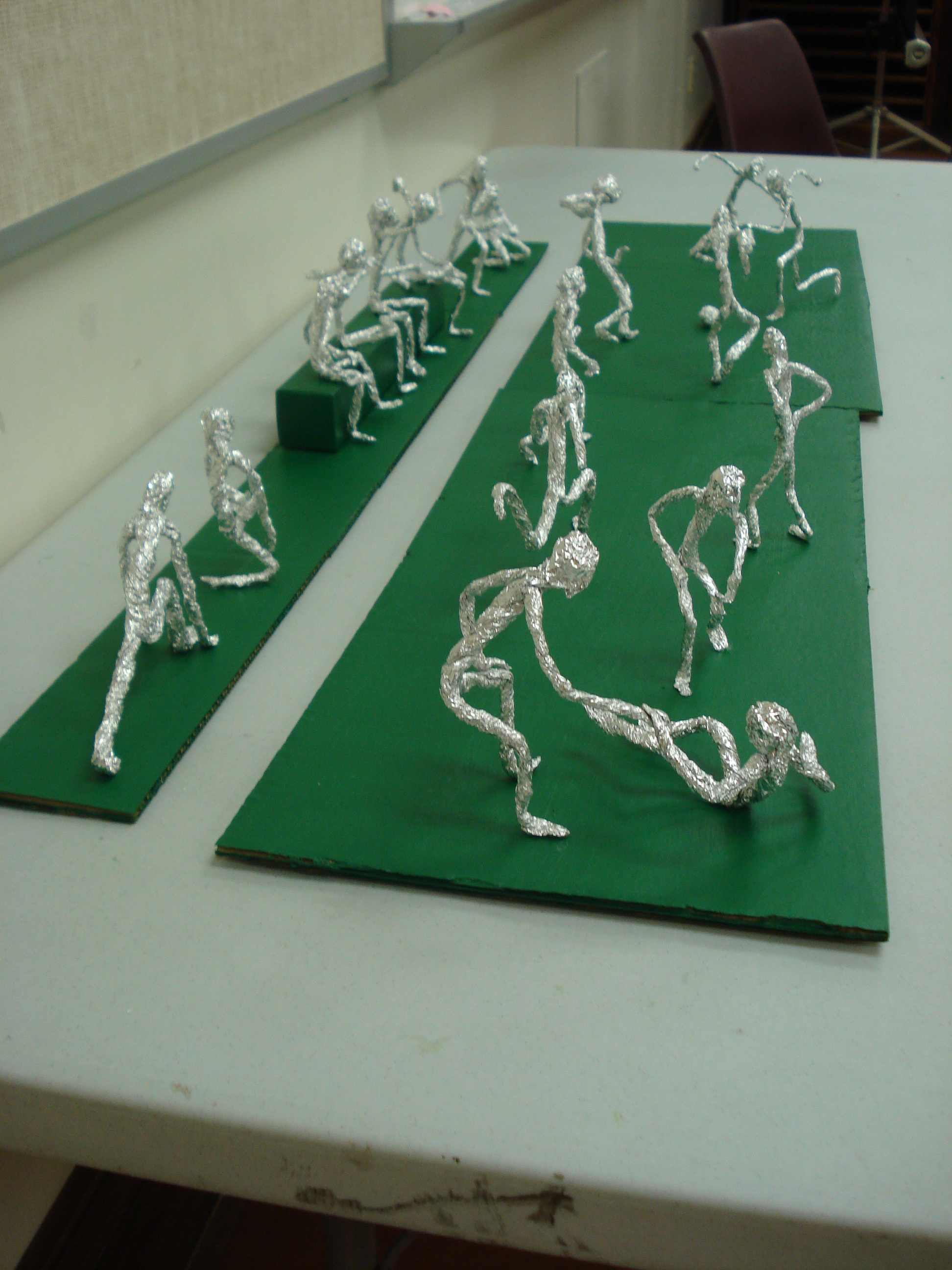
As for writing, I’m mostly considering what kind of love offerings Eric can leave for Lia. Something that would appeal to the artist in her and only later strike her as a bit creepy. Like maybe little dioramas made out of scrunched up tinfoil. Never heard of this? It’s one of my favorite crafts. A couple years ago, I made an entire soccer game for the Northside Branch Library. Why? Why not? Does that make me weird?

Aztec Diet Day 37: Beautiful Warts

Pounds Lost: 18

Breakfast and Lunch: All Day Blueberry Banocado Plus; Snack: low-fat cottage cheese and an apple; Dinner: Tuna on sprouted grain bread; Snack: celery and zucchini chips; Late Snack: almond milk

I feel like the guy in Green Eggs and Ham. I keep avoiding celery as a snack, yet I tried it last night on my break at work and it kept me fairly full and more alert than expected. I topped this off with a few zucchini chips at my desk. Yes, they’re wafer thin. But they absorb water so they make you fuller than you would think. I didn’t even tap into the bag of air-popped popcorn I brought. Note: When making zucchini chips, salt them SPARINGLY. Especially if you are using RealSalt or Celtic sea salt. The chips shrink down, intensifying anything you put on them. So my first batch of chips wound up really salty.

Down side? I wound up ravenous at 11 p.m. Thus the late glass of almond milk.

Yesterday I told Eric I had an opening for a stalker in my next book. He said he’d take it. Then he me to give him hair and make him taller. Ain’t gonna happen. Eric is really cool, just the way he is, short and prematurely bald. He’s upbeat, fun and funny and helpful. Making him conventionally handsome would be a slap to his coolness.

I told Tom (real life model for “Jim” in my books) that Jane made him sound too young and sexy for his part. (Did I stick my foot in my mouth? Probably, I’m a Sagittarius. We do that) I said I was going to have her fix it. He says, It’s okay. You don’t need to change it.” Thing is, I (and many others) love Tom for his simplicity and his good heart. Making him sound like George Clooney is like saying that’s not enough.

Decade ago, “Vogue” was hesitant to feature Cher on the cover because A. She wasn’t blond. and B. She has a bump on her nose. Guess what. That cover outsold all the previous issues.

As an artist, what makes up our “style” is really the way we deviate from the norm. The “norm” is perfection. So our style is really based on our faults and how we deal with them. The art is in turning a fault into a thing of beauty.

Writers love warts. They’re what make us all memorable and different. When we read, we love people who have no filters, who aren’t perfect. A story isn’t a story without mistakes.

In real life, those of us who are sane hate people like Martha Stewart, who are perfectly groomed, perfectly organized and color coordinated, and do everything perfectly well. With flair.

So why do we go through life wishing we were taller, prettier, shorter, richer, more successful, anything-er but what we are? If we could see ourselves through the eyes of someone who loves us, we could abandon our insecurities.

I know all this. I’m still not giving up the diet. It’s a health issue. Yeah, that’s it.


All Day Blueberry Banocado Plus.

Banocado means the base is a banana and an avocado. Plus means I added a big handful of spinach. This is perfect for two servings or for an all-day smoothie.

    1 Cup blueberries
    1 banana
    1 avocado
    1 large handful of baby spinach
    2 – 4 TBSP ground chia seeds
    1 heaping TBSP cacao powder or cocoa (Optional)
    1/2 TSP ground ginger (optional)
    Water, to desired consistency